
2025 was the year of hyping up AI. 2026 is the year of being smart about AI

AI is moving past experimentation. Real impact now depends on strategy, cultural readiness, and better decision-making. The challenge is no longer adopting AI—but understanding how to use it with clarity, purpose, and long-term value.
We’ve heard it all about AI, or so we think.
The hype, the over-promising, the doom-saying. But most of all, the noise. The constant drone of speculation about what AI can or will do.
In the process, a lot of people have lost sight of what AI actually is. And what it really means for businesses and society.
If you want to successfully integrate AI, you need to cut through the noise. 2026 will be the year of being smart, conscientious, and critical about AI. It will be the year of figuring out how to truly unlock its potential.
It will also be the year of learning to collaborate with AI, of identifying how AI automation fits alongside human decision-making.
Mostly, it will be the year of giving AI time to shine.
Good things happen to those who wait
Perhaps the biggest problem with AI right now is, actually, very human: impatience.
Of course, it’s not the large language models being impatient, it’s us. It’s businesses expecting instant, magical results. It’s users who bought into a shortcut only to find a long road ahead.
Because AI adoption will indeed be a long road.
Transforming business models, value chains, and work culture will not happen overnight. And gains will not be immediate.
On the contrary, there might be some setbacks along the way. Many companies applying AI are seeing productivity losses in the short term. Others are even encountering increased workload and inefficiency.
Roughly 40% of United States workers are regularly dealing with “workslop”. That is, they’re receiving useless AI generated output from their colleagues, which they then have to check, correct, and often redo entirely.
Unsurprisingly, some workers are checking out from AI. According to recent Census Bureau data from the United States, AI use at work might actually be falling in the past few months.
These growing pains are to be expected. AI isn’t an add-on, it’s not plug-and-play. To really take advantage of it, organizations need to reskill their workforce, update their legacy systems, redraw their workflows, and revamp their infrastructure.
AI is a fundamental shift in how we do business. It’s not the missing piece of the puzzle but an entire new set of pieces. And it’s going to take time for us to see the full picture.
But are businesses willing to wait?
The costs of impatience
Impatience with AI can take two forms.
One, as we just saw, is decreased use and indifference. Which might lead companies to eventually invest less on AI.
But that would be a mistake, because AI is not a cost. Instead, it’s what will keep your business relevant in the decades to come. It’s a booming global market that, by 2033, will grow to $3.5 trillion, over three times its current size.
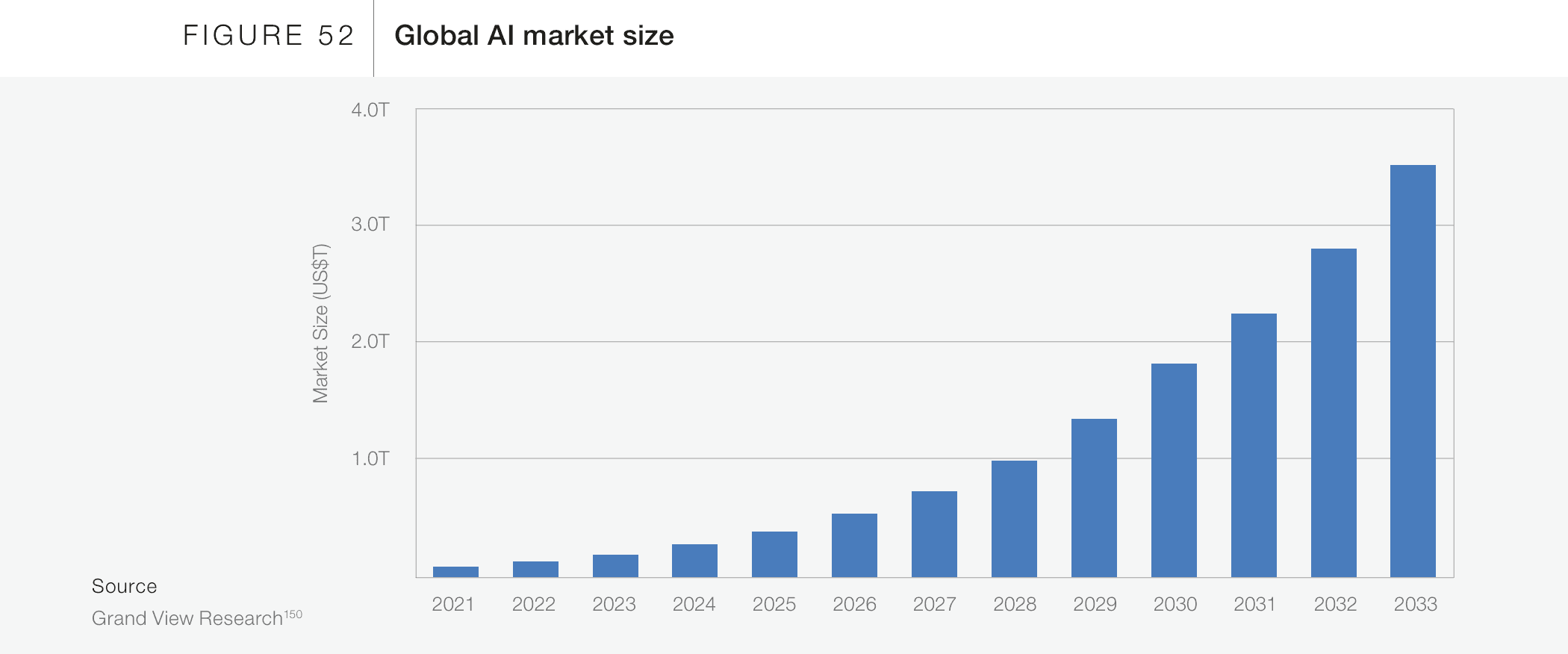
(The Global Risk Report 2026, World Economic Forum, 2026, Figure 5.2)
Yet something else is also true. AI is much more than an automation tool. It’s more than a way to (eventually) increase efficiency.
AI is an invitation to rethink your business, how you generate value, how you make decisions, how you train your collaborators, and how you compete in the market. And all this requires careful planning and consideration.
Because rushing AI, or being thoughtless about it, is just as tragic as ignoring it.
In its report on global risks, the World Economic Forum warns about some of the potential consequences of implementing AI. Or rather, implementing it badly and haphazardly.
We’re talking about rising unemployment, growing inequality, and greater political instability in an international context that is volatile enough as it is.
Even worse, the expansion of AI could lead to a loss of human meaning. With young people competing for fewer entry-level positions in increasingly automated industries, they might struggle to imagine a future for themselves.
So how do we avoid all this? By evolving as much as our technology.
Evolving your business alongside AI
In a recent conversation I had with Mariana Camino, CEO of Abeceb, we discussed — among other topics — the challenges of adopting new technology. And I pointed out a pattern I have seen countless times.
Companies will decide to innovate and invest in advanced tools. They will have the talent and resources at their disposal to meet their goals. In fact, they will have no reason to fail. And yet they do, time and time again.
Why? Because they haven’t undergone the necessary cultural transformation. They haven’t laid the groundwork for technological adoption to actually happen, and their people and processes aren’t ready for change.
So if you want to integrate AI into your business, you need to rethink everything.
Rethink how you’re upskilling your workforce. Embrace continuous learning as part of your projects and budgets, so your teams can keep up with the ever-changing nature of AI.
Rethink silos. Or break them down entirely. Help teams work together to understand when AI is useful and when it’s likely to hallucinate and generate useless outputs.
Rethink your data. Is it readily available, searchable, and usable by AI models? Or is it scattered across obsolete systems? Perhaps you should consolidate your data sources in a data lake.
Yet amidst all this change, one thing should remain constant: your purpose.
AI needs to be a continuation of your company narrative, even as it leads towards uncharted territory. That will give you a solid place to stand on. So everyone can feel confident and empowered, even in the face of uncertainty.
And through it all, you should take care of the people around you, preventing burn out and cognitive overload, ensuring access to mental health services, and promoting proper dietary and sleeping habits.
For technology to thrive, humans need to thrive as well. There is no progress that’s not, ultimately, also human progress.
Share on:





Stay Ahead with Expert Tips, Trends, and Insights
Get the latest content from Santex: ideas, tech updates, and resources that matter.
Like