
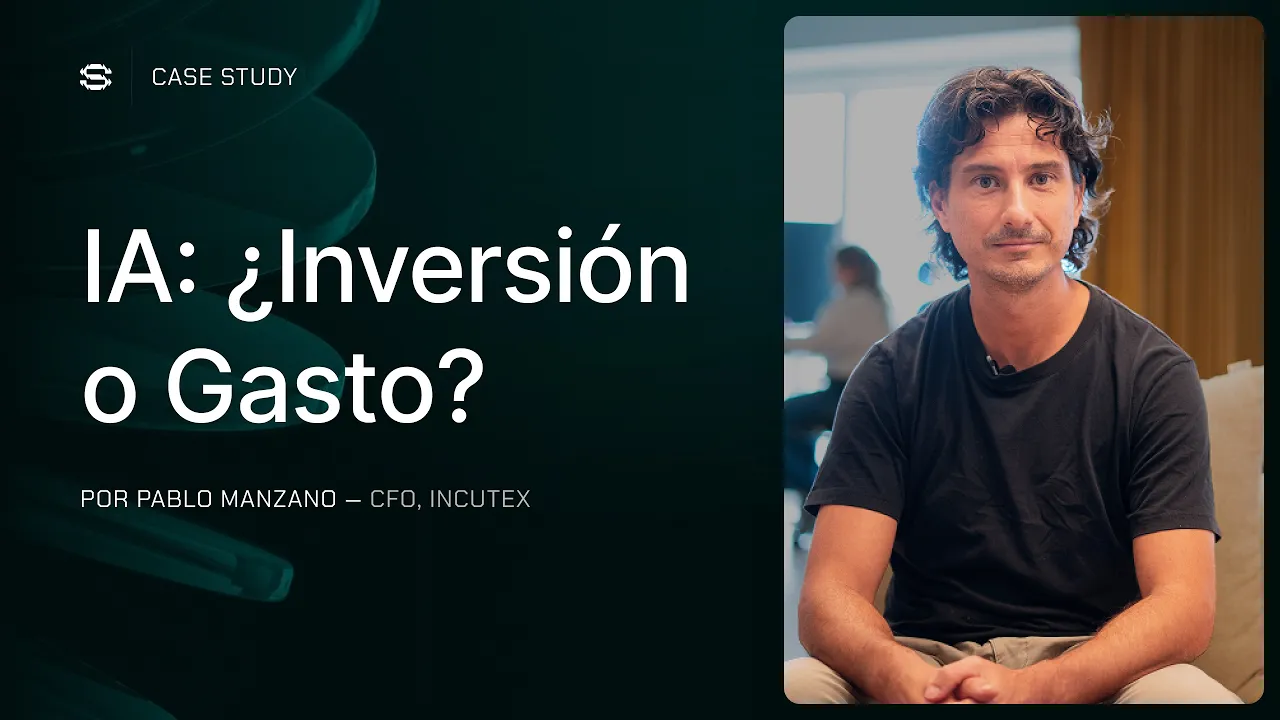
AI: Is your project creating value or consuming budget?

95% of AI projects fail to deliver ROI. Here’s how to measure real return, reduce uncertainty, and make investment decisions with both financial and technical criteria.
Technological optimism is colliding with financial reality.
According to MIT NANDA, 95% of Generative AI (GenAI) projects fail to achieve a desirable return on investment (ROI). What we’re seeing is the rise of the “GenAI Divide”: a critical gap between the majority of companies stuck in endless experimentation and the select 5% that have successfully embedded real value into their P&L.
While the market has poured between $30B and $40B into GenAI initiatives, the reality for most CTOs is frustrating. Budgets are being consumed by “perpetual pilots”—solutions that work in controlled environments but collapse when scaling to production.
This is not a model capability problem. It’s an architecture and strategy problem.
And in the next 12 to 18 months, that gap will become irreversible for those who fail to transform how they operate.
Why your AI project is likely to fail (and how Santex prevents it)
To move into the 5%, companies need to address root causes. Failure is not technological—it’s structural.
At Santex, we focus on solving three critical barriers that drain innovation budgets:
Static models vs. agentic orchestration. Most AI implementations suffer from a learning gap. They rely on prompt-based systems with no memory, no feedback loop, and no contextual understanding. Santex addresses this through agentic orchestration and persistent memory, enabling AI systems to learn from interactions and adapt to real workflows.
Brittle workflows. Many solutions are designed to perform well in demos—but fail in real-world conditions. Without a strong verification layer (such as agentic RAG connected to proprietary data), productivity gains are lost in constant human supervision.
The “Shadow AI” trap. There is a growing perception gap. While leadership assumes limited adoption, between 90% and 92% of employees are already using ungoverned AI tools.
The leading 5% of companies capture this demand by deploying enterprise-grade solutions—reducing cybersecurity risks and centralizing value creation.
The Santex roadmap: the science behind ROI
At Santex, we act as trusted advisors to de-risk innovation investments. Our role is not just to build technology—but to turn it into a predictable financial asset.
We use a Value Driver Tree to map how operational metrics directly impact EBITDA.
Our project evaluation methodology ensures economic viability through five key steps:
Value driver identification: We focus on high-impact levers such as call deflection, revenue assurance, and back-office efficiency.
Investment structure (CapEx & OpEx): MVP and middleware development are treated as capital investment, enabling long-term marginal cost reduction.
Cost savings quantification: We calculate the cost gap between human and automated operations, including a 15–20% reduction in average handling time (AHT).
Free cash flow model (FCF): Three-year projections considering technological obsolescence.
Financial valuation framework:
NPV: Value creation based on discounted future cash flows
IRR (USD): Minimum 12% hurdle rate to justify technological risk
ROIC: Capital efficiency compared to generic solutions that fail to generate competitive advantage
Case study: Digital transformation & AI in the Oil & Gas industry
This case demonstrates how our methodology turns structural inefficiencies into financial assets, across an operation with over 130,000 customers.
Initial Situation | Santex Solution |
|---|---|
56% failure rate in digital channels, driving costly human support demand. | AI conversational assistant (MVP) + “360° Middleware” integrated with SAP. |
High volume of manual, repetitive queries (billing, reconnections). | Automated identity validation and debt status checks through real-time data orchestration. |
Validated financial results:
IRR: 71.46%
NPV: $257,000 USD
ROI: 104%
Operational impact: $13,000 USD saved in the first quarter
30% call deflection and 15–20% AHT reduction
The CTO dilemma: build internally or partner with experts?
The numbers are clear: organizations that partner with experienced teams achieve a 67% success rate, compared to just 33% for internal developments.
Many internal teams fall into a “dangerous overconfidence” after a successful pilot. But failure typically occurs in the final stretch: production stability, memory persistence, and legacy system integration.
Santex provides a proven roadmap—built on resolved failures and tested patterns—to accelerate time-to-value and prevent teams from getting stuck maintaining brittle solutions.
Conclusion: Don’t be part of the 95%
The strategic window is 12 to 18 months.
Companies that cross the gap now will operate with decreasing marginal costs. Those who don’t will remain trapped in manual processes and failed pilots. AI success is not about implementing the largest model. It’s about designing systems that learn from your business.
If you’re evaluating an AI investment and still can’t clearly define its expected return, the problem is likely not technical. It’s a decision problem.
At Santex, we work alongside business and technology teams to turn initiatives into viable, measurable, and scalable investments. Schedule a diagnostic session and evaluate the real ROI of your next AI project.
Don’t let your strategy become part of the 95%. Turn it into a driver of growth.
Share on:





Stay Ahead with Expert Tips, Trends, and Insights
Get the latest content from Santex: ideas, tech updates, and resources that matter.
Like