
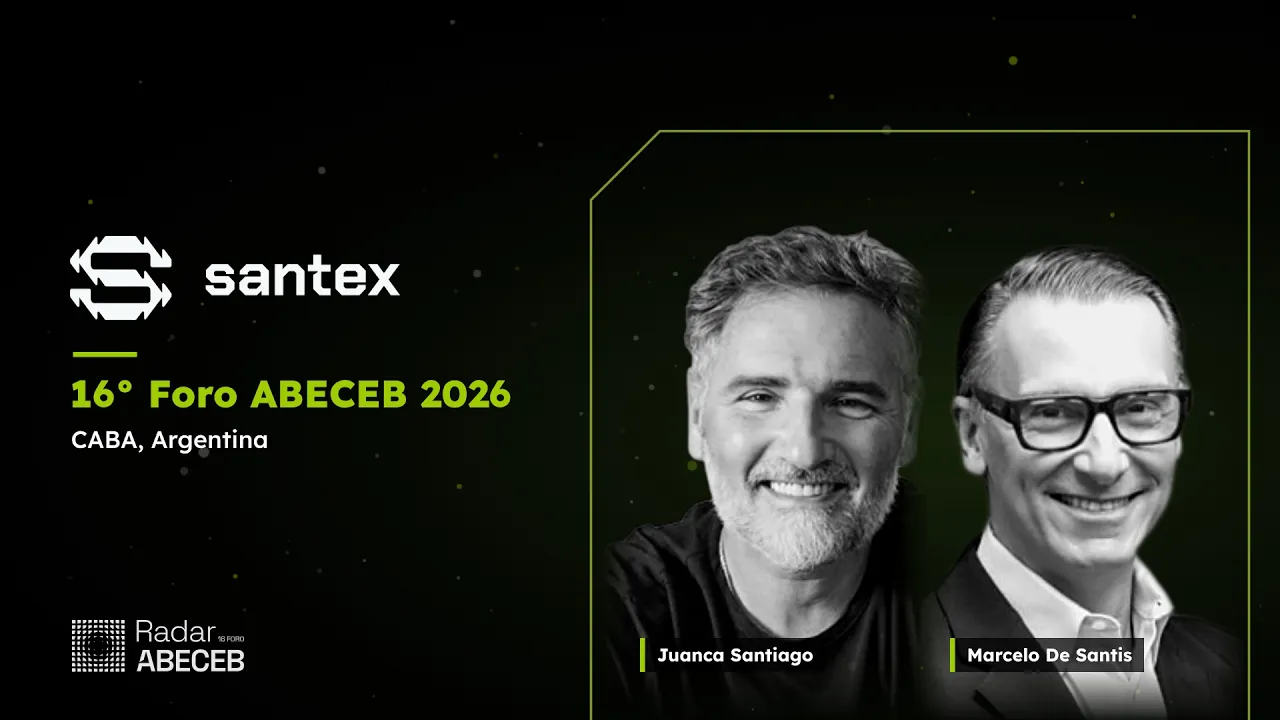

At Foro ABECEB 2026, Juanca Santiago and Marcelo De Santis debated where competitive advantage with AI lies when anyone can rent the algorithm. Watch the full talk.
Any company can pay 20 dollars a month and get the same AI model as its competitors. If the technology is within everyone’s reach, competitive advantage with AI has to come from somewhere else. That was the question behind Passenger or Pilot, the ABECEB Talk shared by Juanca Santiago, CEO & Founder of Santex, and Marcelo De Santis, CEO and founder of The Ascent, at the 16th Foro ABECEB, held on November 5, 2026, in Buenos Aires. Marcelo is a former Fortune 500 CDO and CIO who has led technology and digital transformation at Mondelēz, Kraft Foods, and Pirelli.
You can watch the full talk here (in Spanish).
“It’s Not a Technological Era. It’s an Era of Awareness”
Juanca opened with a premise: “They want us to believe the era we live in is technological, but it isn’t. It’s an era of awareness.” If everyone has access to the same technology, “the problem is leadership.”

AI, he explained, “is an object. It’s a tool”: intelligence without consciousness. We are the subject, and our job is to govern it. That starts with asking questions in the right order. A tool that speeds up a process speeds up the good and the bad alike, so before adopting any solution you have to identify the problem you’re trying to solve. One line sums up the whole talk: “LLMs and algorithms are rented. Awareness and capability are built.”
What Companies That Do See Returns Do Differently
Marcelo cited a study by Universidad de San Andrés: AI currently contributes about US$4.3 billion to Argentina’s GDP, with business adoption at around 11%. If the country reached levels like Uruguay’s, it would add roughly another US$5 billion by 2030. Argentines don’t lack judgment, he said. What’s hard is integrating AI into business processes.

To show what changes when that integration works, Marcelo turned to Nubank and shared a clip from an interview with David Vélez, its founder and CEO. Every company uses the same AI, but Nubank built four things around it: more than fifteen years of proprietary data, redesigned processes, granular measurement of the value AI adds to each process, and AI fluency in the CEO and the leadership team.
On processes, Marcelo was clear: “If you put AI on top of a current process, which is probably inefficient, you’ll keep paying the cost of that process and you’ll pay for AI tokens on a process that doesn’t work.” It’s one of the reasons so many companies struggle to measure the return on their AI investment.
Passenger, Spectator, Absent, or Pilot
For Marcelo, AI fluency combines two things: knowing how to use it to create business value, and having “enough judgment to decide when to trust the AI’s output, when to check it, and when to actually throw it out.” Cross the two and four archetypes appear:
Passenger: uses AI without questioning it. Raises risk, reputational risk included.
Spectator: has the judgment but doesn’t use it, out of fear or after a bad experience.
Absent: thinks AI is an IT matter and keeps doing the same thing.
Pilot: uses it and knows how to judge it. Where we all want to be.
The data backs this up. According to a BCG study of 563 executives, published in September 2026, mature AI on its own delivers a 20% competitive advantage, a well-prepared leadership team delivers 66%, and the two together deliver 80%. Yet only 36% of leaders feel their senior team is prepared.
Lead, Redesign, Set Limits
Marcelo closed with three ideas:
Lead. The leader’s hands have to be on the wheel.
Redesign processes instead of putting AI on top of today’s.
Set limits in every process: what the person does, what AI does, and what they do together, starting with AI doing the bare minimum.

He also raised a warning about young talent: if AI does the work through which a junior learns judgment, where will tomorrow’s leaders come from? “Just because we can automate a process or an activity with AI doesn’t mean we have to.”
AI, he said, is like a Formula 1 car: fast, powerful, and with only one seat.
“Passenger or pilot. It’s your call.”
The Algorithm Is Rented. Judgment Is Built
The advantage isn’t in having AI, because everyone has it. It’s in proprietary data, redesigned processes, and leaders who can decide what to do with that intelligence and own the decision.
The next day, the conversation continued with CEOs, CIOs, and CTOs at our Buenos Aires office. We explore this in "The One Thing AI Can’t Copy from You" a look at governance, judgment, and responsibility.
At Santex, we bring together software engineering, data, and AI to put that transformation into practice, and we do it in-house first: we run more than 20 in-house agents in production, with STX Agents built into our teams’ daily work. The agent executes. A person reviews and decides.
Which process in your business needs to change? Our AI consulting team works on exactly that. Let’s talk about where to start.
Share on:



Like