

AI Agents vs. Claude for Teams: Why I’d Recommend Agents to a Colleague

Generic AI tools solve individual tasks. Specialized agents transform team processes. Why the shortest path to real impact isn’t more licenses.
Three out of four companies plan to adopt agentic AI within the next two years. Yet only one in five currently has the governance maturity required to sustain it. According to Deloitte’s State of AI in the Enterprise 2026, based on responses from 3,235 business and technology leaders across 24 countries, that gap is not a budget problem. It is a design problem. And it begins before the first license is purchased.
Before going any further, one clarification: this is not Claude versus agents. The agents I refer to in this article often run on the very same models—Claude, GPT, Gemini—that anyone can open in a browser. The difference is not the engine. It is everything designed around it: what context it can access, who it shares that context with, and which rules govern how it operates.
Most management teams arrive at AI through the same door: a ChatGPT, Claude, or Gemini account, a few hours of experimentation, and the feeling that this could change a lot. Sometimes it does. But often, the tool becomes productive for the person who discovered it and remains almost invisible to the rest of the team.
That was my entry point too. It was useful, challenging, and revealing. But the learning stayed on my screen, and the process depended too heavily on individual effort. A specialized agent starts from a different premise: it does not solve my individual task; it addresses the team’s process. It becomes another member of the team—not a tool each person configures independently, but part of a hybrid team that interacts with me, my colleagues, and the processes we share.
The Difference That Matters Isn’t the Model
The best-known AI tools—ChatGPT, Claude, Gemini—are extraordinarily capable in isolation. They write, summarize, explain, and answer questions. The limitation is not the quality of the model. It is that they know nothing about my company, my team, or my processes until I provide that information. That puts all the responsibility on me: whether the interaction is useful depends on how well I establish the context and provide the right information in every session.
A specialized agent does the opposite. It operates within a defined context and knowledge base, making interactions relevant to a specific function and organization. I do not have to explain who we are every time I start a conversation.
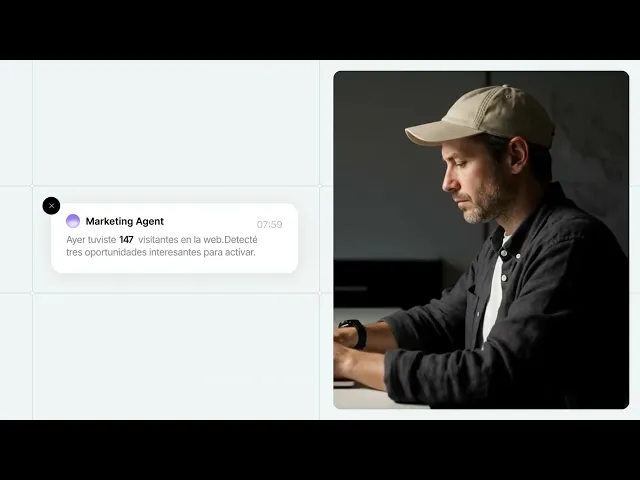
At Santex, we use more than thirty of our own agents across sales, marketing, delivery, People, and finance. Our team is no longer just a group of people. It is a hybrid team made up of humans and agents working across the same processes, in the same channels, with the same context. What I learned through that process goes far beyond technology.
The challenge is cultural: it means overcoming mindset barriers, creating a shared learning process, and discovering that things we had never even imagined become possible once agents are part of the team.
Seven Reasons I’d Recommend This Approach to a Management Colleague
1. Adoption Focused on Impact, Not Exploration
With Claude or ChatGPT, everyone follows a different path. Some use it for writing, others for research, and some do not open it for weeks. The result is fragmented: plenty of individual activity, but little measurable impact on the underlying process.
A specialized agent is designed for a specific use case. The team does not have to decide how to use it: it has a defined purpose, an expected workflow, and adoption metrics from day one. The team’s energy is directed toward concrete outcomes rather than open-ended, individual experimentation.
2. Shared Practices That the Whole Team Can See
One of the least visible frictions of individual AI tools is that learning does not circulate. If I discover an excellent way to use Claude for a particular process, that practice stays in my head—or, at best, in a message no one will ever find again.
An agent that lives in the team’s channel does exactly the opposite: every interaction is visible, the criteria are explicit, and practices are developed collectively. Operational knowledge stops living with one person and becomes part of a shared process that gets smarter over time. That is only possible when the agent is part of the team, rather than an individual extension of each person.
3. Security That Settings Alone Can’t Guarantee
Generative AI platforms offer privacy settings that, when used correctly, can mitigate risk. But “used correctly” requires every person on the team to know exactly what they can share, under which plan, with which provider, and under what terms. In practice, maintaining that consistency is difficult, and the rules need to be reviewed and updated as the organization’s needs evolve.
An agent designed for the team has boundaries defined from the start. It only accesses what it needs, operates within company systems, and treats data rules as part of the design rather than something left to individual usage. Security does not depend on each person making the right judgment in every session.
4. No Distracting Investment Decisions
Which plan should we choose? Does the team need the Pro tier, or is the free version enough? Is Enterprise worth it? Should access be centralized, or should everyone pay for their own account? What happens if the price goes up next year, and under what conditions?
With an agent designed for the team, that conversation largely disappears. The investment becomes a business decision based on clear criteria: which processes it addresses, how much it costs to operate, and what return is expected. It can be evaluated like any other management tool.
5. No Friction From Setup or Role Administration
Mass-market platforms require teams to manage who can access what, define capabilities by role, monitor token consumption by user, and update those settings whenever someone joins or leaves the team. That administrative work often falls to someone who should not be spending their time on it.
A specialized agent has roles defined as part of its design. Administration is not an ongoing task; it is an architectural decision made upfront.
6. A Cost You Can Forecast
The cost of generative AI tools scales with usage and varies by provider. For teams that use them heavily, the combined cost of individual licenses can exceed the cost of an agent designed specifically around the team’s processes. The advantage is not always on the agent’s side—it depends on volume and process complexity—but while individual subscriptions can fluctuate month to month, the cost of operating an agent is known from the design stage. There are no surprises at the end of the month, and that is enough to make the decision based on data rather than assumptions.
7. Provider Independence
Mass-market AI tools tie users to a specific provider’s model. If prices rise, the model’s behavior changes, or a better alternative appears, migrating means starting much of the adoption process over again.
A well-designed agent is model-agnostic—whether it runs on Claude, GPT, or whatever comes next. If the provider changes or a more suitable option becomes available, the agent can adapt without the team noticing a meaningful difference. The investment is in the process and the integrations, not in the model.
What Doesn’t Change
One thing still matters: the quality of what a specialized agent produces does not depend only on how well the use case was defined when the agent was designed. It also depends on what happens afterward, once the agent has returned an answer and the person still has work to do.
That work is augmentation: iterating with the agent, not accepting the first response, comparing its perspective with your own, correcting its blind spots, and pushing toward the best possible version. Without that iteration, a well-designed agent can end up producing the same kind of output as a poorly used individual account: something that looks finished but is not. There is already a name for it: workslop—AI-generated content delivered without the human review and judgment it required, creating more work for the person receiving it than it saved for the person who produced it.
The advantage does not come automatically from having an agent, or even from designing the problem well. It comes from someone staying involved after pressing “send.”
The Question I Keep Asking Myself
Individual generative AI tools are a good starting point for understanding what AI can do. But the difference between exploring AI and working with AI is the same as the difference between having access to data and making decisions with data. The input may be the same. What changes is whether the agent is a tool each person opens in a browser or a member of the team that shares the same context, channels, and goals as everyone else. The first option scales individual work. The second transforms how the team works.
That is what a hybrid team looks like. And I believe that is where we are headed.
If you are deciding where to start, do not start with the tool. Start by mapping a team process that currently depends on someone remembering to open the right chat. That is where you will find the first agent worth deploying. Contact us and schedule a demo.
Share on:



Stay Ahead with Expert Tips, Trends, and Insights
Get the latest content from Santex: ideas, tech updates, and resources that matter.
Like